弦音圣殿弦音圣殿
HomeCollectionFine BowsMastersTradingProductsPre-OwnedAccessoriesRentalsRepairsOrchestraAbout中文
Violin TempleViolin Temple

China's largest exhibition and appraisal center for award-winning violin makers. Dedicated to the collection, exhibition, and trading of fine classical string instruments, delivering exceptional service to music lovers.

Products

  • Collection
  • Fine Bows
  • Masters
  • Trading
  • Products
  • Pre-Owned

Services

  • Accessories
  • Rentals
  • Repairs
  • About

Contact Us

  • 📞 +86 19910221529
  • ✉️ fredtaylor@coze.email
  • 📍 北京市朝阳区音乐产业园6栋迪贝斯音响馆

© 2026 弦音圣殿 Violin Temple. All rights reserved.

京ICP备2026024174号

首页/Interviews/I dream of these violins even in my sleep.

I dream of these violins even in my sleep.

Interviews提琴珍宝馆管理员 May 28, 2026
I dream of these violins even in my sleep.

VSA Tone Award winner Liang Zhiling is the first Chinese luthier to receive this honor in the quartet category. He advocates a "free love" wood selection philosophy—arguing that the pairing of the back plate and top plate is more important than the grain pattern, inspired by repeated observations of master violins in Italian museums. His family began repairing violins in Xiguan, Guangzhou in 1935, and the craft has been passed down through four generations—an extremely rare lineage in China's lutherie industry. After his father's health was compromised by long-term inhalation of toxic varnish, he developed an eco-friendly varnish that has passed EU SGS certification, allowing the wood to breathe and enhance sound projection. He confronts a key industry issue: a Chinese-made violin of the same quality sells for 100,000 yuan, while a high-imitation Italian violin sells for 400,000 to 500,000 yuan—China does not lack craftsmanship, but lacks pricing power and a brand system. Violin Temple is establishing circulation records and soundprint archives for resident luthiers, gradually building a valuation system for Chinese makers. His lutherie creed: "To make a great violin, you need to understand sound—but you don't necessarily have to know how to play."

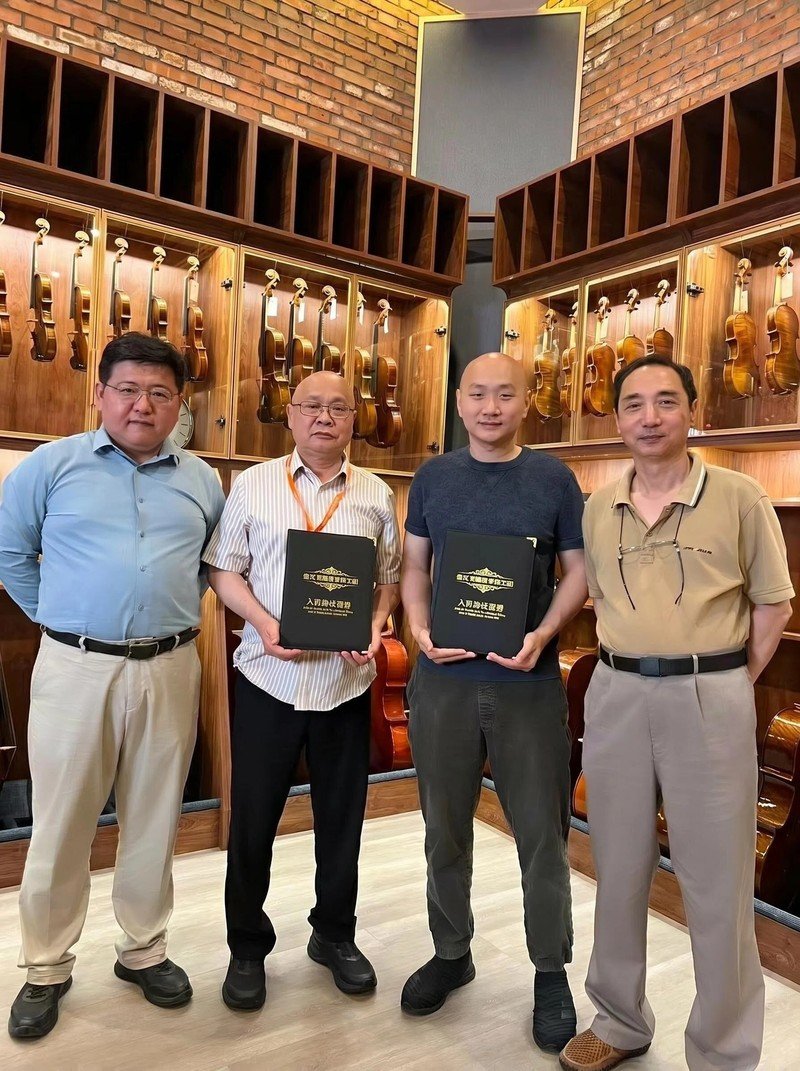
Violin Temple · People Dreaming of These Violins Even in Sleep VSA Tone Award Winner Liang Zhiling and His Four Generations of Violin Making Liang Zhiling (second from left) signing the agreement to join Violin Temple In 2012, at the judging session of the Violin Society of America (VSA) International Competition, a luthier from Guangzhou experienced the most unexpected moment of his life—his quartet piece won the Tone Award. "I couldn't believe it myself," Liang Zhiling recalled. It was the first time a Chinese luthier had won the Tone Award in the VSA quartet category. From 2012 to 2024, he won multiple awards, almost always for tone—not craftsmanship. Craftsmanship is visible; the Tone Award is invisible. "Craftsmanship, appearance, varnish, assembly—all are visible from the outside; only tone is invisible. Tone requires deep accumulation and a long-term understanding of sound. If a luthier has reached the level of pursuing tone and can win an award, it shows he has mastered certain principles." — Violinist Hao Li The Philosophy of "Free Love" in Wood Selection Winning the Tone Award is not luck. Liang Zhiling has a unique philosophy in wood selection and pairing— "As soon as someone talks about the beauty of the grain, I know they don't understand violins," he said. "What really matters is the material quality and how it's paired." He gave an analogy: "It's like marriage—two people forced together aren't necessarily happy. Making a violin is the same. A particular back plate doesn't automatically match a particular top plate. You have to find the right match through 'free love,' so the 'divorce rate' is lower, and the violin is more harmonious." Beyond competitions, his understanding of sound comes from a deeper source—the master violins in Italian museums. Every time he went abroad for exhibitions, while others toured, he stayed in museums. "For a whole week, I went in as soon as the museum opened, looking at those Stradivaris and Guarneris, not wanting to leave." He could only observe through display cases—the arching, color, rib thickness, and f-hole shapes. "I dream of these violins even in sleep." A Story Beginning in 1935 In China's violin-making industry, family traditions reaching the fourth generation are, to Liang Zhiling's knowledge, almost nonexistent. "Maybe two generations, but three or four are very rare." The starting point of this legacy was 1935 in Guangzhou's Xiguan district. His grandfather, Mr. Huang Da, founded a violin workshop there. In those days, Xiguan and the Thirteen Hongs area were concessions, where many British, French, and Americans came for business, bringing violins and guitars. When strings broke or glue came loose, they brought them to Huang Da's workshop for repair. "My grandfather thought these instruments were good, so he studied them in reverse. It started with repairs—fixing them while observing their shape, measurements, thickness, and then gradually began making them," Liang Zhiling said. "I truly admire them, my ancestors—they seemed to understand just by looking." Hao Li added the reality of that era: "In the past, China had no complete violin-making system. The violin shapes we saw as kids might have been drawn from newspapers; f-holes were even made by poking holes with needles." In 1954, Huang Da's workshop merged with seven others to form Nanlian Musical Instrument Factory—the predecessor of Guangdong Musical Instrument Factory (Kapok brand). Liang Zhiling is the third generation, and his son Liang Zhenyu is the fourth. "Because this craft is still hard and labor-intensive, I know many luthiers whose parents still make violins, but their children have mostly switched careers. Passing it down is very difficult." Liang Zhenyu's entry into the craft wasn't driven by passion from the start. "In middle and high school, I wasn't particularly interested in anything. Later, I followed my father to the factory and started from sharpening knives." He had doubts along the way until he gained industry recognition—"Once you achieve a sense of accomplishment, it becomes a positive cycle, and you grow to love it more." "It's not innate love from the beginning; most of the time, you gradually gain a sense of mission through the work." From left: Violinist Hao Li, Violin Temple's Tian Lifu, Liang Zhiling, Liang Zhenyu "Our Varnish—I'd Even Eat It" Liang Zhiling's eco-friendly varnish has passed the EU SGS certification. The development of this varnish stemmed from a painful family memory. "It's related to my father. He used to work in a factory making guitar varnish. Back then, many varnishes had strong odors, containing formaldehyde and toxic gases. Working during the day and overtime at night, long-term inhalation harmed his health. People from that era really suffered." Liang Zhenyu added a technical explanation: "Traditional varnishes contain aldehydes or resinous substances that, when inhaled long-term, can affect the nervous system. We developed eco-friendly varnish to ensure raw materials are as natural and harmless as possible." To find suitable natural materials, Liang Zhiling traveled across Hainan, Indonesia, and Malaysia. He mentioned an interesting discovery: some people observed old violin varnish under a microscope and found "structures even resembling bee legs"—because in that era, chemical industries were underdeveloped, and many materials came from nature. Stradivari's varnish remains undeciphered to this day for the same reason. "Craftsmanship and structure can be seen and learned, but varnish is extremely difficult. Good varnish helps sound production; bad varnish suffocates the wood like a pot lid. Good varnish penetrates through the pores, allowing the wood to breathe while providing surface protection." — Violinist Hao Li Liang Zhiling's final assessment of his varnish is simple: "When you smell our violins through the f-holes, it's mostly the scent of wood. The sound of the bare wood and after varnishing doesn't change much—it even gains more charm and texture." No matter who claims their varnish is good, it must at least be eco-friendly. This is a luthier's obsession inherited from his father and the baseline he sets for the industry. Between 100,000 and 400,000 Liang Zhiling once made a violin that professionals felt was better than some Italian ones, yet its price was three to four times lower. "Some high-imitation Italian violins sell for 400,000 to 500,000 Hong Kong dollars; our violins are around 100,000. Some professionals think ours are better, but market perception differs. They're Italian; we're Chinese—that's the current problem." This isn't an isolated case but a systemic challenge facing China's violin-making industry: skill is not lacking, but pricing power and voice are. China is one of the world's largest violin producers and exporters, but most Chinese luthiers can only price based on costs—materials, labor, taxes, space—just enough to survive. Once a violin is labeled with an Italian brand and passes through several intermediaries, its price can multiply several times. "Chinese luthiers should enter the brand era. Famous foreign luthiers have a value system—their new violins have clear prices on official websites or channels, and they appreciate in value. Master Liang and his son's works should also have such a system: original works, signed, meeting certain standards, forming a clear value." — Violinist Hao Li Establishing a brand era requires infrastructure currently lacking in the Chinese market: a second-hand violin circulation market, records of use by famous musicians, and auction transaction data. "Many foreign luthiers post these records online—which violin was sold to which musician, which musician's family auctioned it after their death for a high price, boosting the luthier's reputation." Violin Temple is attempting to do this—establish long-term circulation records and sound archives for luthiers on the platform, ensuring every violin's journey from production to each transfer is traceable. "If every transaction of a violin in the second-hand market is recorded and announced, its value will have continuous market documentation," said host Tian Lifu. Making a Good Violin Requires Understanding Sound, But Not Necessarily Playing A long-standing saying in the lutherie circle goes: "If you can't play, you can't make a good violin." Fourth-generation luthier Liang Zhenyu directly refutes this: "Players don't necessarily listen carefully to the violin's own sound; they may focus more on their technique, trying to make the violin produce better sound. We do the opposite: first make the violin well, so the player can easily produce good sound. The starting point is different." Stradivari and Guarneri—the two greatest luthiers in history—have no clear records of them playing. But this doesn't mean communication between luthiers and players is unnecessary. Hao Li, with decades of experience using violins, said: "I've always played domestic violins, collaborating with Guan Kaiming for 30 to 40 years. Each time, I tell him: where this violin can be adjusted, whether the response is quick, how the balance is, whether the outer string is too bright or the inner string too dark. Through years of磨合, luthiers learn what sound players want." Liang Zhenyu emphasizes that luthiers must have independent tonal aesthetics: "First, eliminate subjective factors. A violin needs several elements: first, focus; second, balance; third, no harshness. Harshness means it sounds grating. Achieve these first, then adjust according to the preferences of players and enthusiasts." — Fourth-generation luthier Liang Zhenyu It's not "you must play to make a good violin," but "making a good violin requires understanding sound, and understanding sound doesn't require playing." "When we go to competitions, we also make pre-adjustments based on local weather. These are years of accumulated experience and key to why we almost always win the Tone Award." From 1935 to 2026, nearly a century, four generations, the same craft. In China, this alone is a rarity. Perhaps in the near future, Chinese luthiers' violins won't need an Italian surname to prove themselves. Violin Temple · Treasure Hall 640㎡ Professional Acoustic Showroom · Building 6, Beijing Music Industrial Park Appointment for trial: 19910221529 Interview by Tian Lifu / Edited by Sun Yiwei
← Back to Articles