Youth OrchestraAugust 19, 2026· 乐团场记
Dibes Youth Symphony Listening Program: This Week's Repertoire - Tchaikovsky's "The Nutcracker"
December 18, 1892, at the Mariinsky Theatre in St. Petersburg. A ballet choreographed for Christmas premiered, causing little stir at the time. But over a century later, it has become the most frequently performed ballet worldwide—every Christmas season, from the Metropolitan Opera in New York to the Royal Opera House in London, it is staged simultaneously in dozens of countries. Without it, Christmas would be incomplete.
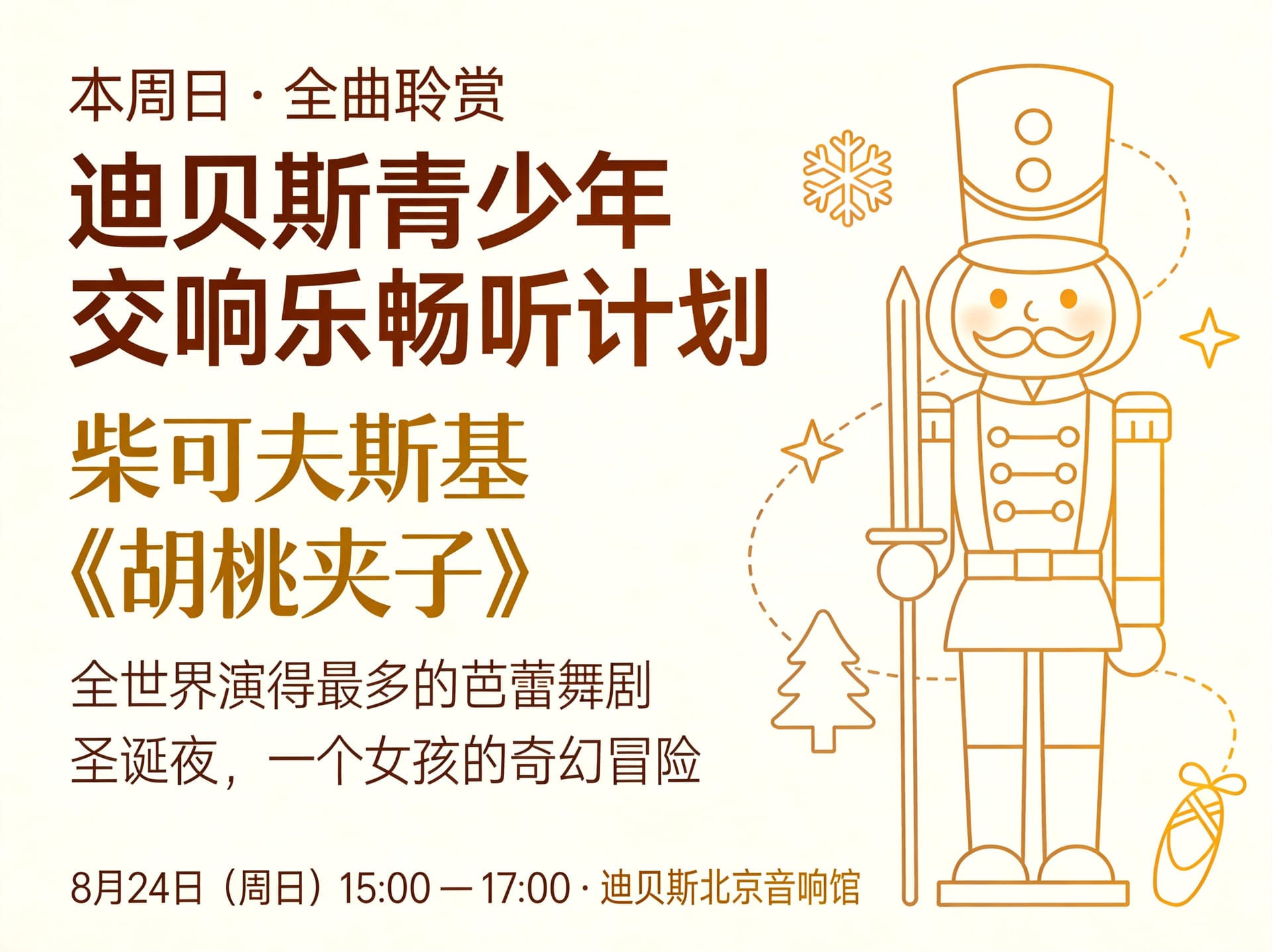
This Sunday · Complete Listening
DIBEISI Youth
Symphony Listening Program
Tchaikovsky's "The Nutcracker"
The most performed ballet in the world
On Christmas Eve, a girl's fantastical adventure
🗓️ August 24 (Sunday) 15:00 – 17:00 · DIBEISI Beijing Audio Hall
THE WORK
The most performed ballet in the world
On December 18, 1892, at the Mariinsky Theatre in St. Petersburg, a ballet choreographed for Christmas premiered without much fanfare. But over a century later, it became the most frequently performed ballet in the world—every Christmas season, from the Metropolitan in New York to the Royal Opera House in London, it is staged simultaneously in dozens of countries. Without it, Christmas is incomplete.
🎄
"The Nutcracker" Op. 71
Premiered 1892 · Approx. 85 minutes · Two-act ballet
Tchaikovsky · Celesta used for the first time in orchestral music · Waltz of the Flowers · Approx. 85 minutes
Act I
Christmas Eve
Christmas party, attack of the Mouse Army, the Nutcracker transforms into a Prince, March
Transition
The Land of Snow
Snowflakes swirling, Clara and the Nutcracker Prince journey through the snowy forest
Act II
The Kingdom of Sweets
Dance of the Sugar Plum Fairy, character dances from around the world, Waltz of the Flowers
Finale
A glorious conclusion
Full ensemble, the grand celebration of the Kingdom of Sweets
CONTEXT
Without these three things, there would be no Nutcracker
Tchaikovsky did not write this work out of thin air. Behind him were three material conditions transforming the music world:
The maturation of the steel-frame piano — After Érard invented the steel-frame piano in 1825, string tension tripled, allowing the piano to produce a brighter, more crystalline sound. Tchaikovsky's obsession with "bright timbre" directly influenced his exploration of orchestral color—later, in Paris, he discovered a new instrument: the celesta, whose sound was like bells and water droplets combined. He immediately brought it back to Russia and used it for the first time in "The Nutcracker"
The commercialization of public theaters — In the late 19th century, large public theaters in Paris and St. Petersburg entered the era of commercial operation. The Christmas slot required a work suitable for the whole family. "The Nutcracker" was born under this commercial logic—it is not just a work of art, but also a cultural consumer product
The production chain of literary adaptation — German Romantic writer Hoffmann wrote a fantastical story about a nutcracker; French writer Alexandre Dumas (father of the author of "The Lady of the Camellias") adapted it into a stage-ready libretto, and then it moved from text to dance. From novella to ballet, each step of adaptation was an industrial transformation
"The Nutcracker" was not a bolt of divine inspiration—it was a product jointly brought forth by instrument craftsmanship, theater commercialization, and literary adaptation. Understanding these three things, you can hear why this work "had" to appear.
DEEPER
It is not just a fairy tale
On the surface, "The Nutcracker" is a girl's fantastical adventure on Christmas Eve—the Mouse Army, a talking nutcracker, the Kingdom of Sweets. But in music history, it represents a pivotal turning point: orchestral color entered a new phase.
Tchaikovsky first heard the sound of the celesta in a bell foundry in Paris—a timbre somewhere between bells, piano, and crystal, which immediately made him think of the "Sugar Plum Fairy." He secretly brought the instrument back to Russia, preventing anyone else from using it first. When the celesta first sounded in the "Dance of the Sugar Plum Fairy," audiences worldwide were stunned—they had never heard such a sound in an orchestra.
Ever since, whenever a "magical" scene appears in film, the score often features the celesta—this tradition began with "The Nutcracker."
LISTENING GUIDE
Director Wang guides you through these four moments
🎺
March: The children rush toward the Christmas tree
The most instantly memorable passage of the entire ballet. Strings ascend rapidly, like a group of children too excited to stop, with woodwinds imitating the marching of toy soldiers. This is the ballet's opening—the image of children rushing toward the Christmas tree
✨
Dance of the Sugar Plum Fairy: The magic of the celesta
That crystalline, dreamlike timbre—like water droplets and bells—is the celesta. Tchaikovsky discovered this unprecedented instrument in Paris and used it to create the sound of "candy dripping." This was the first time in music history anyone had used such a timbre
🌸
Waltz of the Flowers: The most magnificent moment of the ballet
A solo horn introduces the theme, then the full orchestra surges in—this is the grandest, most sumptuous passage of the entire ballet. Late Romantic orchestral writing reaches its ceiling here
🌍
Character dances: Painting a world map with timbre
Russian Dance (Trepak), Chinese Dance, Arabian Dance, Dance of the Mirlitons—Tchaikovsky "painted" the colors of different nations through varied instrumental combinations. Listen carefully to how he uses orchestration to distinguish geographical character
SPEAKER
This session's guide
Wang
Wang Jiangtao
DIBEISI Beijing Audio Hall Director
Seasoned audiophile and classical music enthusiast. Under his stewardship, DIBEISI Beijing Audio Hall houses a flagship million-level Hi-Fi audio system and five themed listening rooms, making it one of the few professional spaces in China capable of reproducing the live sound field of a symphony orchestra with top-tier audio equipment. This session, Director Wang will present a complete listening guide and in-depth interpretation of Tchaikovsky's "The Nutcracker."
DETAILS
Event Information
📅
Time
August 24 (Sunday) 15:00 – 17:00
📍
Venue
DIBEISI Beijing Audio Hall
Building 6, Beijing Music Industrial Park
🚇
Metro
Line 7 · Heizhuanghu Station, exit and you're there
🚗
Driving
Ample parking available within the park, convenient access
🎯
Target audience
Idyllic Symphony Youth Public Welfare Orchestra, A Group and B Group, all members
💰
Fee
Free, public welfare event
NOTICE
Friendly Reminders
👶
Age requirement
Audience members must be at least 5 years old. For children under 5 with listening needs, a one-on-one private session can be arranged—please contact Director Tian or Director Wang.
📋
Venue and group size
A minimum of 10 people schedules the Golden Hall; a minimum of 4 people schedules the boutique small hall; if fewer than 4, the event will be postponed or canceled. Registration deadline: Friday 9 PM.
🎧
Weekend opening
The Audio Hall is open as usual on Saturdays and Sundays. For personalized music listening or equipment experience needs, please contact us separately.
 Idyllic Symphony Youth Public Welfare Orchestra × DIBEISI
Idyllic Symphony Youth Public Welfare Orchestra × DIBEISI