Music EducationSeptember 20, 2026· 田园交响青少年公益乐团
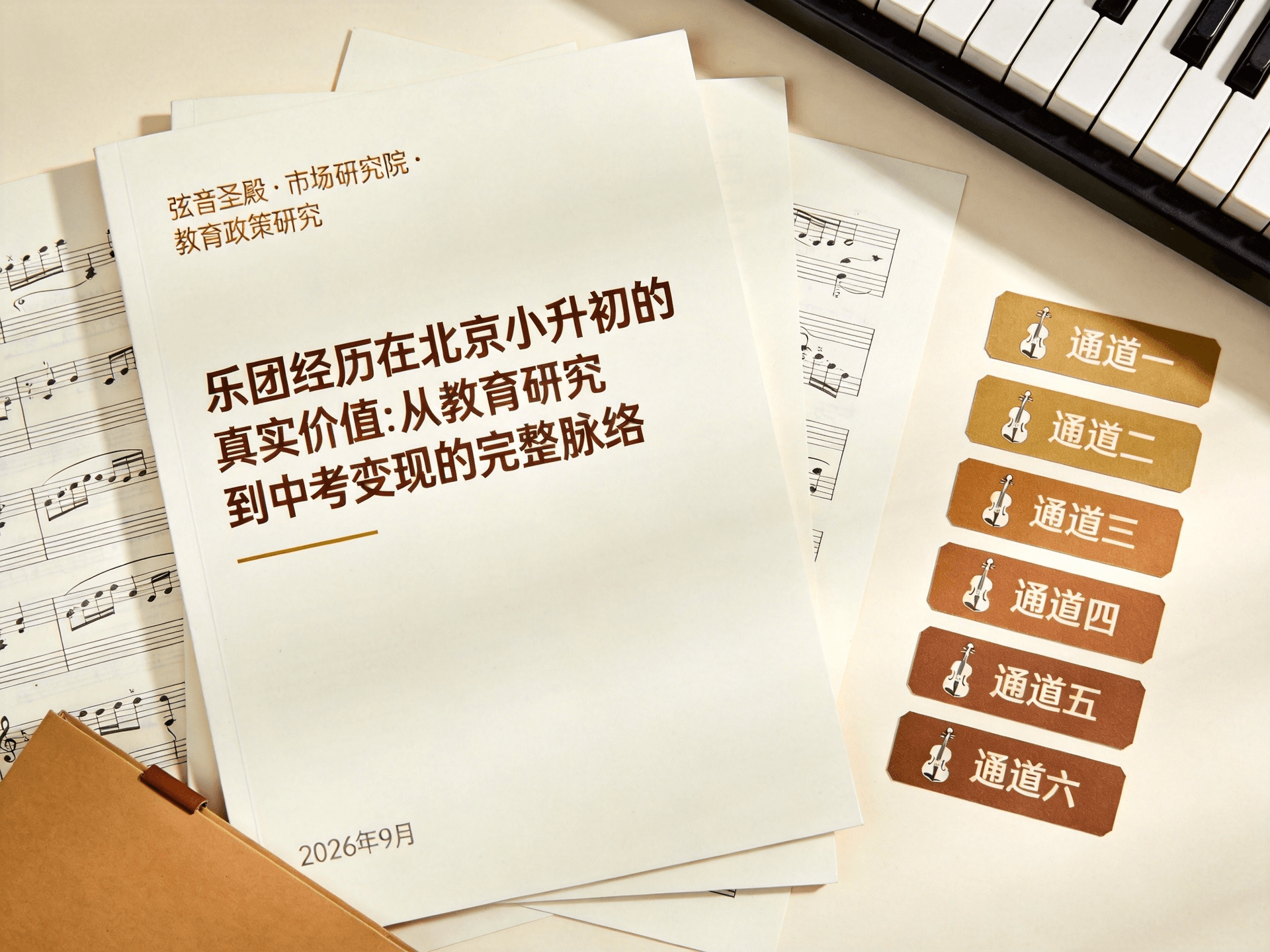
The Real Value of Orchestra Experience in Beijing's Primary-to-Middle School Transition: A Complete Trajectory from Policy Abolition to Its Payoff in the High School Entrance Exam
Many parents ask: if a child has orchestra experience and plays at a decent level, can they use this to get into a good school for the primary-to-middle school transition? This report is based on official 2025-2026 documents from the Ministry of Education, the Beijing Municipal Education Commission, and the education commissions of Xicheng, Changping, and Tongzhou districts. It connects "why the policy was abolished -> how districts implement it -> the real situation for the primary-to-middle school transition -> opportunities after enrollment -> cashing in at the high school entrance exam" into one complete thread, without padding it out with marketing copy.
Violin Temple · Market Research Institute · Education Policy Research Briefing · September 2026 · Beijing Primary-to-Middle School Transition Special Topic
The Real Value of Orchestra Experience in Beijing's Primary-to-Middle School Transition:
The Complete Chain from Policy Cancellation to Zhongkao Monetization
Many parents ask: If my child has orchestra experience and decent performance ability, can they use this to get into a good school during the primary-to-middle school transition? This report is based on official documents from the Ministry of Education, Beijing Municipal Education Commission, and the Education Commissions of Xicheng/Changping/Tongzhou Districts for 2025-2026, connecting "why the policy was cancelled → how districts implement it → the real situation in primary-to-middle transition → opportunities after enrollment → zhongkao monetization" into a complete chain, without padding with marketing copy.
Produced by: Violin Temple Treasure Hall · Market Research Institute, September 20, 2026
Coverage Areas: Xicheng · Changping · Tongzhou | Policy Period: 2025-2026 Enrollment | Sources: Ministry of Education/Municipal Education Commission/District Education Commissions/School Official Websites
Core Conclusions | Why Cancelled | How Districts Implement | Real Situation in Primary-to-Middle Transition | Opportunities After Enrollment | Zhongkao Monetization | Advice for Families | References
Core Conclusions
During the primary-to-middle school transition (primary to junior high), orchestra experience and performance ability provide no practical advantage in the admissions pathway. This is not a special policy of any particular district, but a national policy implemented since 2019, with Beijing taking the lead in enforcement, now lasting 7 years.
But this does not mean orchestra experience has no value—its value lies not in the primary-to-middle transition admission process, but in three subsequent stages: ① Priority opportunities to join high-level junior high orchestras (such as Jinfan Orchestra) after enrollment; ② The official monetization channel through art specialty student admissions during the zhongkao stage (junior to senior high); ③ Long-term accumulation in the comprehensive quality portfolio, which has indirect effects in zhongkao "1+3" cultivation experiments and other stages.
Simply put: Primary-to-middle transition relies on lottery placement, after enrollment relies on orchestra, zhongkao relies on specialty students. Orchestra experience is a "delayed gratification" path, not a "plug-and-play" admissions tool.
I. Why Cancelled: The Underlying Logic of National Policy
Understanding "why there isn't" is more important than knowing "there isn't."
1.1 Original National Policy Text
In 2019, the Ministry of Education issued the "Notice on Doing a Good Job in 2019 Ordinary Primary and Secondary School Admissions," explicitly requiring: "All localities shall gradually reduce the scale of specialty student admissions until all types of specialty student admissions are cancelled before 2020." Beijing took the lead in enforcement from 2019, being one of the first provinces nationwide to implement this.
In 2026, the Beijing Municipal Education Commission's "Opinions on Doing a Good Job in 2026 Compulsory Education Stage Admissions" (Jing Jiao Ji Er [2026] No. 7) further tightened: "It is strictly prohibited to use examination scores and various competition certificates, training competition results, grading certificates, etc. as admission basis, and it is strictly prohibited to select students through interviews, evaluations, receiving resumes, and other forms."
1.2 The Underlying Logic of Cancellation
Fairness First: Preventing Art from Becoming a New Class Filter
If, when school aesthetic education supply is still uneven, "knowing how to play an instrument" were broadly counted in admissions, the result would be predictable: families with payment ability could gain advantages through enrolling in classes, purchasing instruments, and hiring private tutors, while families lacking resources might not even have the opportunity to encounter instruments. Art would rapidly alienate into a new class filter.
Block the Old, Build the New: First Close the Old Door, Then Build the System
The state simultaneously carries out two types of actions: on one hand blocking—cancelling bonus points, prohibiting grading certificate linkage, strictly prohibiting training institutions from using admissions to skim top students; on the other hand building—requiring schools to offer complete art courses, equip teachers, conduct all-staff exhibitions, and run art clubs well. After schools' own aesthetic education supply becomes relatively balanced, evaluation weight will gradually increase.
Lottery Placement as Primary: Compulsory Education Exemption from Examinations and Nearby Enrollment
Primary-to-middle transition belongs to the compulsory education stage, with the core principle being exemption from examinations and nearby enrollment. Beijing implements "registration enrollment + computer lottery placement (lottery)," which is essentially random computer assignment, with the comprehensive quality portfolio not participating in screening or ranking.
II. How Districts Implement: Admission Methods in Xicheng, Changping, and Tongzhou
The primary-to-middle transition admission methods in the three districts are highly unified, all primarily based on lottery placement, with no art specialty student channels whatsoever.
Table 1: Comparison of 2026 Primary-to-Middle Transition Admission Methods in Three Districts
| District | Admission Methods | Art Specialty Students | Public Boarding |
|----------|-------------------|----------------------|----------------|
| Xicheng District | ① Nine-year consistent direct advancement ② District-wide lottery placement ③ Special schools/boarding schools/private schools ④ Corresponding direct advancement lottery placement ⑤ School district registration enrollment ⑥ School district lottery placement enrollment | None | None |
| Changping District | ① District-wide lottery placement ② Corresponding direct advancement ③ Single-school zoning ④ Multi-school lottery placement ⑤ District-level coordination ⑥ Public boarding system ⑦ Private schools | None | Yes (but does not consider art) |
| Tongzhou District | ① Single-school zoning ② Multi-school joint computer lottery placement | None | None |
Key Fact: None of the three districts issued any primary-to-middle transition art specialty student admission notices in 2025 or 2026. The "specialty student admission" documents that can be found online (such as Xicheng District No. 161 Middle School's 10 wind music specialty students) are all senior high stage (junior-to-senior high/zhongkao) policies, completely unrelated to primary-to-middle transition.
2.1 Xicheng District "Special Schools" ≠ Art Specialty Students
In 2026, Xicheng District has 6 junior high special schools recruiting district-wide/city-wide, but all are non-art or fine arts: Xu Beihong Middle School (fine arts specialty, city-wide, no more than 20 students), Xicheng Foreign Language School (foreign language specialty), Huimin School (ethnic education specialty), Yuetan Middle School (Japanese language specialty), etc. Special school admissions use computer lottery placement (lottery), not selection based on art level.
2.2 Jinfan Orchestra Constitutes No Admission Preference at Primary-to-Middle Transition Stage
The Beijing Student Jinfan Art Troupe (including wind orchestra, string orchestra, choir, etc.) is a municipal-level student art group, with host schools mostly being quality middle schools. Jinfan Art Troupe host schools can recruit art specialty students city-wide at the "junior-to-senior high" stage (explicitly stated in Jing Jiao Ti Yi [2026] No. 12). However, at the primary-to-middle transition stage, Jinfan experience cannot serve as admission basis, nor does any "Jinfan Orchestra corresponding junior high" channel exist.
III. Real Situation in Primary-to-Middle Transition: The Actual Role of the Comprehensive Quality Portfolio
Many parents have heard that "the comprehensive quality portfolio has an art literacy dimension" and think it can add points in lottery placement. This is not actually the case.
Policy Level: Comprehensive Quality Portfolio Does Not Participate in Lottery Placement at Primary-to-Middle Transition
Primary-to-middle transition lottery placement is essentially random computer lottery, with the comprehensive quality portfolio not serving as lottery placement weight. None of Xicheng, Changping, or Tongzhou Districts have policy provisions indicating that the comprehensive quality portfolio affects lottery placement results.
Comparison: At the zhongkao stage, comprehensive quality evaluation does have mandatory effects—school quota admission requires candidates' comprehensive quality evaluation to reach B level; senior high registration enrollment pilots also require comprehensive quality evaluation to reach B level or above.
What the "Art Literacy" Dimension of the Portfolio Records
The Beijing Junior High Student Comprehensive Quality Evaluation Report Book explicitly has an "art literacy" dimension (fourth dimension), specifically including: performance in participating in municipal/district/school cultural and art activities, learning and mastering art skills and participation in art activities, efforts and results in the art field, and honors at school level and above.
Participating in school orchestras and district-level/municipal-level art exhibitions will be filled into the comprehensive quality evaluation report book as "practical activity records," belonging to the "art literacy" dimension's evidence materials. But this is only a "record" and does not affect primary-to-middle transition lottery placement.
Public Boarding (Changping Only): Condition is "Boarding Need," Not Art
Changping District is the only district among the three that retains the "public boarding system" admission method, but the condition is "having boarding needs," not involving assessment of art experience or performance ability. After enrollment, it is arranged by computer lottery or coordinated arrangement, not selective in nature.
"Point Recruitment" Reality: Strictly Prohibited by Policy, No Reliable Evidence
Some parent circles circulate claims that "prestigious schools make early contact with student sources through school bands/art troupes," but at the primary-to-middle transition stage (compulsory education stage), such operations face extremely high policy risks. 2026 municipal policy further tightened: "It is strictly prohibited for any school to recruit under the name of experimental classes, special classes, etc.," and the Municipal Education Commission will conduct "key supervision and inspection." No reliable evidence indicates systematic existence.
Summary: At the primary-to-middle transition stage, orchestra experience and performance ability have no practical admission advantage in the policy-level non-specialty student channels. Lottery placement relies on lottery, the portfolio only records without screening, public boarding looks at need not art, and "point recruitment" has extremely high risk and no evidence.
IV. Opportunities After Enrollment: The Real Value of Junior High Orchestras
There is no specialty student channel for primary-to-middle transition, but after enrollment, children with orchestra experience have real advantages.
4.1 Junior High Jinfan Orchestra/High-Level Orchestra Recruitment
Some prestigious schools (such as RDFZ, National Day School, Beijing No. 4 Middle School, Beijing No. 8 Middle School, Beijing No. 101 Middle School, etc.) have Jinfan Orchestras/wind orchestras, but these orchestras' member recruitment occurs after enrollment (usually around October of the first semester of junior high), not participating in admission selection. Students with orchestra experience have priority advantages in recruitment.
4.2 Typical Case: Beijing No. 101 Middle School Jinfan Symphony Orchestra
Table 2: Beijing No. 101 Middle School Jinfan Symphony Orchestra Recruitment Requirements (2025)
| Item | Requirement |
|------|-------------|
| Recruitment Target | First-year junior high enrolled students of education group schools |
| Suggested Level | Central Conservatory of Music Grade 9 or performance level; those with primary school orchestral practice experience preferred |
| Assessment Content | Scales and arpeggios, etudes, self-selected works, orchestral excerpt sight-reading, 400-meter run, music cultural literacy |
| Recruitment Time | Around October of first semester of junior high (after enrollment) |
Source: Beijing No. 101 Middle School Official Website
4.3 Other District-Level Inclusive Orchestras
Beijing Youth Symphony Orchestra (affiliated with Beijing Symphony Orchestra)
Ages 9-16 (Grade 3 to Grade 9), requires Grade 7 or above, rehearses every Sunday, first period free.
Source: Beijing Symphony Orchestra Official Website
Shijingshan Youth Symphony Orchestra (ages 8-16)
For Beijing school-registered primary and secondary students, Level 3 or above, free training.
Source: Beijing Daily Report
Key Conclusion: Children with orchestra experience + higher performance ability can, after primary-to-middle transition enrollment, be preferentially admitted to high-level junior high orchestras (such as Jinfan Orchestra). This is the first real value point of orchestra experience—not helping you get into a good junior high, but helping you get into a good orchestra at a good junior high.
V. Zhongkao Monetization: The Official Channel for Art Specialty Students
This is the "formal monetization" stage of orchestra experience in the admissions pathway, occurring in the third year of junior high (junior-to-senior high).
5.1 Policy Basis
In 2026, the Beijing Municipal Education Commission issued the "Opinions on Doing a Good Job in 2026 Senior High School Examination and Admission Work" (Jing Jiao Ti Yi [2026] No. 12), explicitly stating: Jinfan Art Troupe host schools can recruit art specialty students city-wide, with recruitment plans controlled within 4%.
5.2 Typical Case: Xicheng District Senior High Stage Art Specialty Students
Table 3: 2026 Xicheng District Senior High Art Specialty Student Admission Examples (Junior-to-Senior High)
| School | Item | Number | Scope |
|--------|------|--------|-------|
| Beijing No. 161 Middle School | Wind Music | 10 | Xicheng District |
| Xicheng Foreign Language School | Art | Several | Xicheng District |
| Other Jinfan Host Schools | Orchestral/Choir/Dance etc. | Several | City-wide |
Source: Beijing Municipal Education Commission 2026 Senior High Specialty Student Notice; No. 161 Middle School 2026 Wind Music Specialty Student Admission Announcement
5.3 "1+3" Cultivation Experiment
Second-year junior high students can enter "1+3" experimental schools through interviews (exempt from zhongkao, direct advancement to senior high), with experimental schools "combining student junior high comprehensive quality evaluation information" to determine interview lists. Art literacy as part of comprehensive quality evaluation has certain indirect effects in this stage.
Source: Beijing Municipal Education Commission "1+3" Cultivation Experiment Notice (2025)
Key Conclusion: Art specialty student admissions at the zhongkao stage (junior-to-senior high) is the official monetization stage of orchestra experience in the admissions pathway. Jinfan host schools recruit city-wide, with plans within 4%. Children with orchestra experience + higher performance ability can take this channel to enter quality senior high schools in the third year of junior high.
VI. Advice for Families: How to Plan the Value of Orchestra Experience
Based on the above chain, there are three path choices.
Path One: Normal Lottery Placement + Pursue Orchestra After Enrollment
Suitable for: Most families.
Strategy: Normal lottery placement for primary-to-middle transition, participate in high-level junior high orchestra (such as Jinfan Orchestra) recruitment after enrollment. Children with orchestra experience + higher performance ability have priority advantages in recruitment. This is the most reliable path.
Path Two: Target Zhongkao Specialty Students
Suitable for: Families with outstanding performance ability and clear goals.
Strategy: Continuously accumulate orchestra experience and performance ability during primary school, maintain high level during junior high, and apply for senior high schools with art specialty student admission qualifications (such as No. 161 Middle School wind music, Jinfan host schools, etc.) in the third year of junior high. This is the officially recognized "monetization" channel.
Path Three: Long-Term Accumulation of Comprehensive Quality Portfolio
Suitable for: All families.
Strategy: Regardless of whether it is useful for primary-to-middle transition, carefully record the child's orchestra experience, art exhibitions, and awards in the comprehensive quality portfolio. These records have long-term value in zhongkao "1+3" cultivation experiments, senior high comprehensive quality evaluation, and other stages.
Common Point of All Three Paths: None rely on the "specialty student channel" at the primary-to-middle transition stage (because it has been cancelled), but instead place the value of orchestra experience after enrollment and at the zhongkao stage. Orchestra experience is a "delayed gratification" path, not a "plug-and-play" admissions tool.
6.1 Practical Differences Among the Three Districts
Table 4: Practical Advice for Three Districts
| District | Primary-to-Middle Strategy | Post-Enrollment Focus | Zhongkao Target |
|----------|---------------------------|----------------------|-----------------|
| Xicheng District | District-wide lottery/school district lottery, no specialty students | Strive to enter junior highs with orchestra traditions such as No. 8 Middle School, No. 161 Middle School | No. 161 Middle School wind music specialty students (10), Xicheng Foreign Language School, etc. |
| Changping District | District-wide lottery/single-school zoning/public boarding (does not consider art) | Focus on junior highs with orchestra traditions in the district | Focus on Jinfan host schools' city-wide recruitment |
| Tongzhou District | Single-school zoning/multi-school joint lottery, no specialty students | Focus on junior highs with orchestra traditions in the district | Focus on Jinfan host schools' city-wide recruitment |
Appendix References (Official Sources)
Ministry of Education "Notice on Doing a Good Job in 2019 Ordinary Primary and Secondary School Admissions" (2019)
Beijing Municipal Education Commission "Opinions on Doing a Good Job in 2026 Compulsory Education Stage Admissions" (Jing Jiao Ji Er [2026] No. 7, 2026-04-16): Beijing Municipal Education Commission Official Website
Beijing Municipal Education Commission 2026 Admission Policy Interpretation (2026-04-17): Capital Window
Xicheng District 2026 Compulsory Education Admission Implementation Opinions (2026-04-28): Xicheng District Government
Changping District 2026 Compulsory Education Admission Q&A (2026-04-29): Changping District Government
Tongzhou District 2026 Compulsory Education Admission Measures: Beijing Compulsory Education Admission Service Platform
Beijing Municipal Education Commission "Opinions on Doing a Good Job in 2026 Senior High School Examination and Admission Work" (Jing Jiao Ti Yi [2026] No. 12, 2026-04-20): Beijing Municipal Education Commission Official Website
Xicheng District 2026 Special School List (2026-05-13): Xiaoshengchu Website
Beijing No. 161 Middle School 2026 Senior High Wind Music Specialty Student Admission Announcement (2026-05-09): No. 161 Middle School Official Website
Beijing Student Jinfan Art Troupe List: Beijing Municipal Education Commission Official Website
Beijing Junior High Student Comprehensive Quality Evaluation Report Book: Xiaoshengchu Website PDF
Beijing Aesthetic Education Work Action Plan (2022): Capital Window
Beijing Municipal Education Commission "1+3" Cultivation Experiment Notice (2025): Beijing Municipal Education Commission Official Website
Beijing No. 101 Middle School Jinfan Symphony Orchestra Recruitment: No. 101 Middle School Official Website
Beijing Youth Symphony Orchestra: Beijing Symphony Orchestra Official Website
Shijingshan Youth Symphony Orchestra: Beijing Daily
Violin Temple Treasure Hall · Market Research Institute
Beijing Primary-to-Middle Transition Policy Research Briefing | September 20, 2026 | All conclusions can be traced back to official original texts by document number | This report does not constitute an admission promise; local policies are subject to the official release by education administrative departments in the current year
Official Website: violintemple.com