Youth OrchestraOctober 20, 2026· 乐团场记
Idyllic Symphony Youth Public Welfare Orchestra · Classroom Notes: Bowing Is "Not Hard," but the Brain Has to Do Something It Has Never Done Before
Idyllic Symphony Youth Public Welfare Orchestra · Class Notes
Bowing Is "Not Hard"
But the Brain Has to Do Something It Has Never Done Before
Beiyuan Subdistrict 2026 Fall Violin Class · Lesson 2 · October 20, 2026
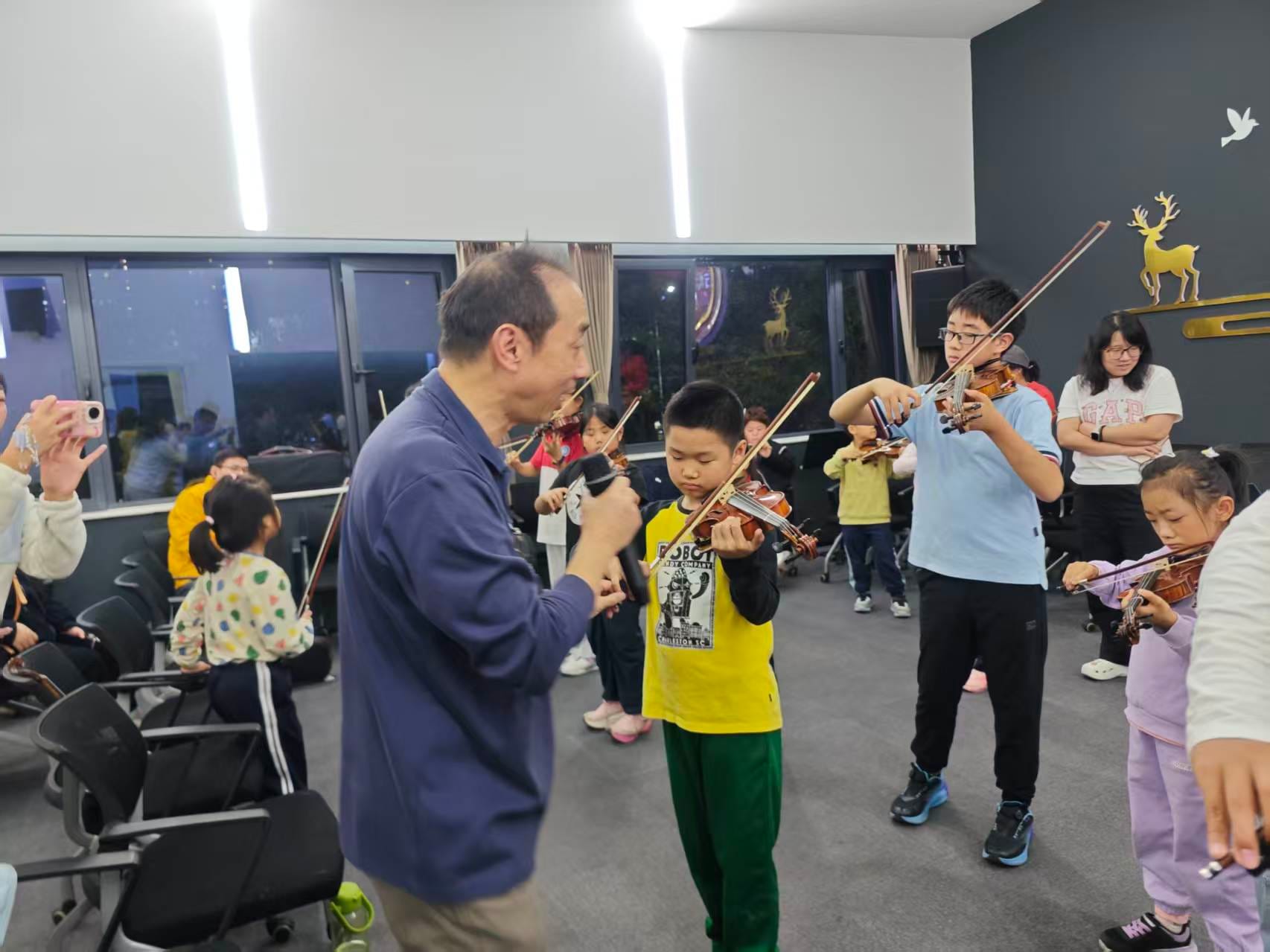
Last night, the Idyllic Symphony Youth Public Welfare Orchestra's Beiyuan Subdistrict 2026 Fall Violin Class held its second lesson. Teacher Hao Li began teaching the children formal bowing—almost the most important hurdle in every beginner violin class.
Interestingly, this hurdle is not difficult because of the movement itself, but because of the brain.
 · · ·
The Movement Itself Is Not Hard
For experienced players, bowing is actually quite simple—keep the bow and strings crossing perpendicularly, let the bow hair rub against the strings, and sound comes out.
That is all there is to the movement itself. But the problem is that beginners often get stuck as soon as they start: "once they notice their hand shape, they forget how to apply force"—either they focus only on posing and the bow freezes on the strings, afraid to move; or as soon as they apply force, they rely entirely on their fingers digging in, with the wrist, elbow, and shoulder all locked up.
Many of the children's hands look very stiff. This is not because they are not serious, but because their brains have not yet learned to connect this whole set of movements together.
· · ·
The Real Difficulty: The Brain Doing This for the First Time
Bowing looks simple, but its demands on the body are actually very strict.
To make the bow hair rub the strings steadily and evenly while keeping the tone pleasant, the body must do the following:
① Fingers—"hold" the bow lightly and steadily, neither pinching nor loosening;
② Wrist—flexibly adjust the angle as the bow section changes;
③ Elbow—move naturally along with the switch between up-bow and down-bow;
④ Shoulder—stay relaxed, not raised, yet still able to transmit force.
These four links must work simultaneously and coordinate with one another, and none of them is a movement used in daily life. For beginners, this is the first time the brain is asked to complete such a delicate, precise task that also requires multiple body parts to work together.
So many children appear "flustered" at first—this is not a matter of ability, but of the brain rapidly learning a whole new motor program.
 · · ·
One Training Session Benefits More Than Just Playing the Violin
The value of this kind of coordination training actually goes far beyond "playing one violin well."
The process of learning an instrument is essentially training the brain's fine control and coordination of various body parts. Hand-eye coordination, left-right brain cooperation, concentration, patience, and perception of rhythm and dynamics—these abilities will stay with a child for life.
A child who has received this kind of training from an early age will not grow up clumsy-handed, whether writing, doing handicrafts, playing sports, or performing delicate experimental operations. This is probably the most long-lasting gift that music enlightenment gives a person.
· · ·
The Birth of a Little "Teacher"
There was also an interesting little episode in this lesson.
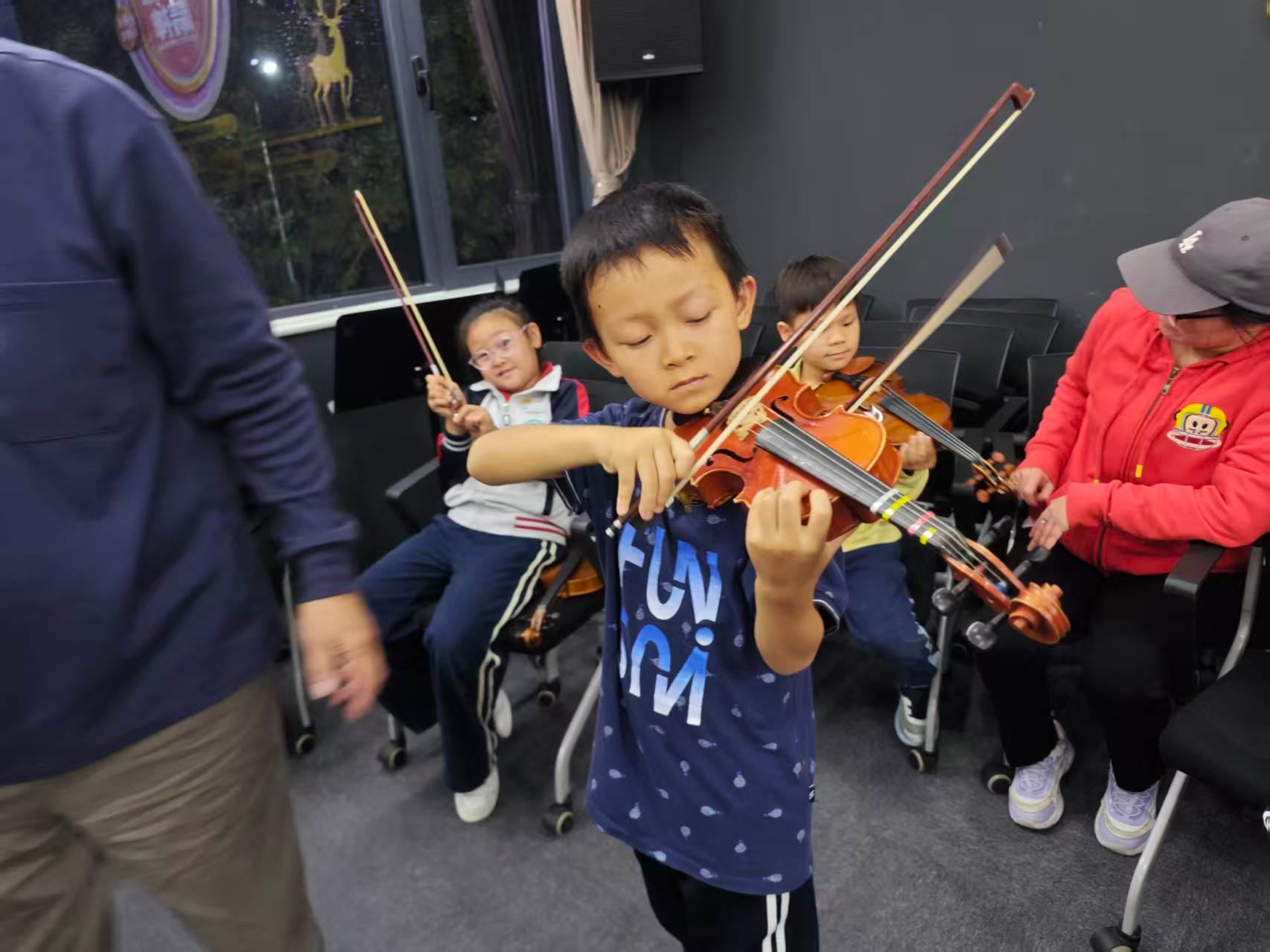
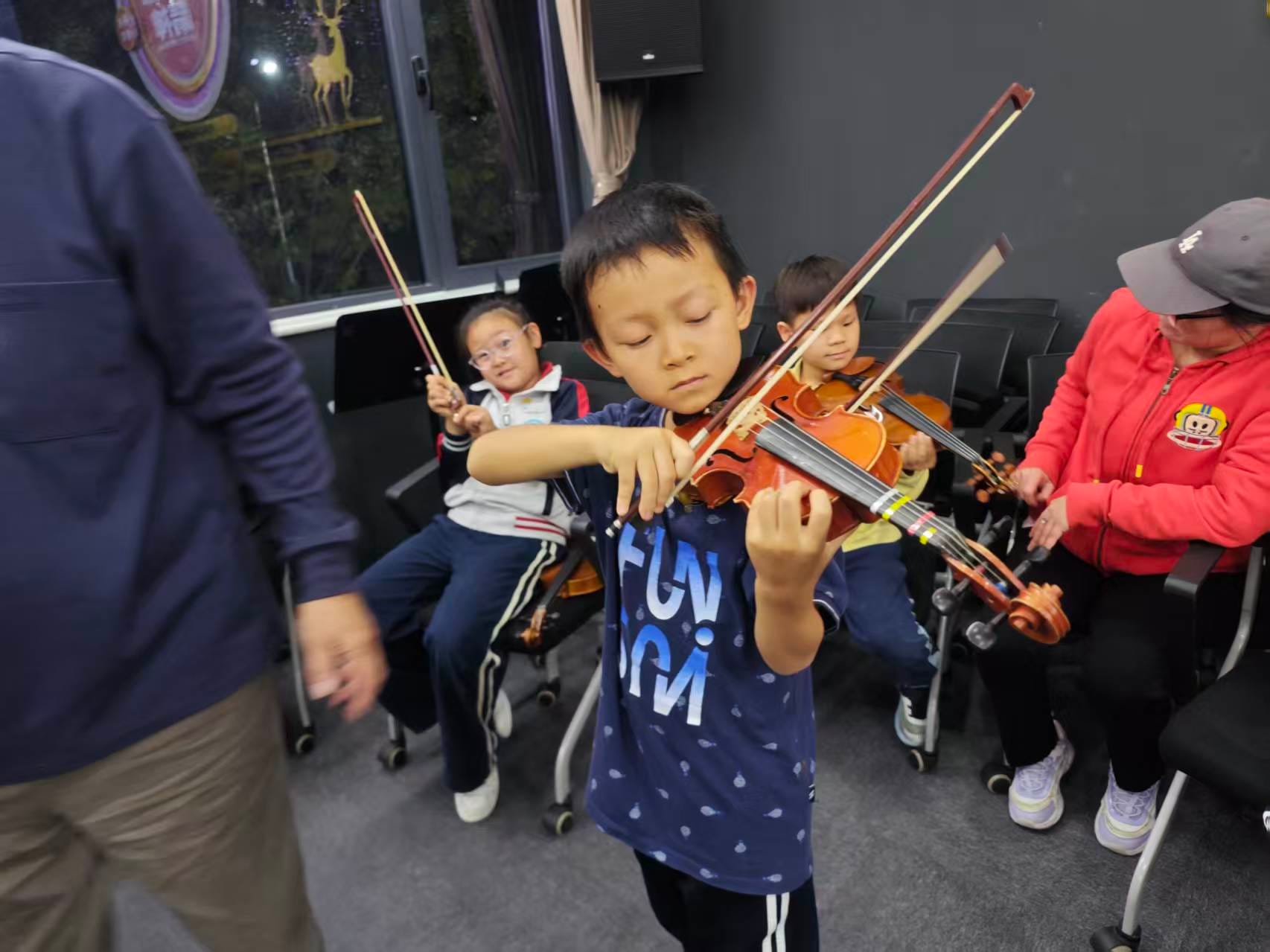
A little boy in the class, without separate instruction from the teacher, got most of the bowing movements right on his own. Teacher Tian and Teacher Hao praised him on the spot and also brought him to the middle of the class to demonstrate for the other children.
The little one was very happy, and his movements became even more energetic.
I believe this moment—"standing in the middle of the class and being called on by the teacher to demonstrate"—will stay in his heart for a long time. A child in the enlightenment stage most needs exactly this kind of experience of recognition—it will become a source of confidence in later practice: "I can do it."
· · ·
Of course, everyone has to get through this stage. No matter how clever a child is, it is impossible to solidify the bowing movement in a single lesson—the muscle memory of the fingers, the flexibility of the wrist, and the relaxation of the shoulder all need day after day of practice to grow.
No child learning the violin can bypass this stage. The good news is that no child truly fails to get through it either.
Take it slowly, and everyone, keep going.
Idyllic Symphony Youth Public Welfare Orchestra
Tongzhou Beiyuan Subdistrict Teaching Site
October 21, 2026
Idyllic Symphony Youth Public Welfare Orchestra · Let Good Music Enter Every Home
· · ·
The Movement Itself Is Not Hard
For experienced players, bowing is actually quite simple—keep the bow and strings crossing perpendicularly, let the bow hair rub against the strings, and sound comes out.
That is all there is to the movement itself. But the problem is that beginners often get stuck as soon as they start: "once they notice their hand shape, they forget how to apply force"—either they focus only on posing and the bow freezes on the strings, afraid to move; or as soon as they apply force, they rely entirely on their fingers digging in, with the wrist, elbow, and shoulder all locked up.
Many of the children's hands look very stiff. This is not because they are not serious, but because their brains have not yet learned to connect this whole set of movements together.
· · ·
The Real Difficulty: The Brain Doing This for the First Time
Bowing looks simple, but its demands on the body are actually very strict.
To make the bow hair rub the strings steadily and evenly while keeping the tone pleasant, the body must do the following:
① Fingers—"hold" the bow lightly and steadily, neither pinching nor loosening;
② Wrist—flexibly adjust the angle as the bow section changes;
③ Elbow—move naturally along with the switch between up-bow and down-bow;
④ Shoulder—stay relaxed, not raised, yet still able to transmit force.
These four links must work simultaneously and coordinate with one another, and none of them is a movement used in daily life. For beginners, this is the first time the brain is asked to complete such a delicate, precise task that also requires multiple body parts to work together.
So many children appear "flustered" at first—this is not a matter of ability, but of the brain rapidly learning a whole new motor program.
· · ·
One Training Session Benefits More Than Just Playing the Violin
The value of this kind of coordination training actually goes far beyond "playing one violin well."
The process of learning an instrument is essentially training the brain's fine control and coordination of various body parts. Hand-eye coordination, left-right brain cooperation, concentration, patience, and perception of rhythm and dynamics—these abilities will stay with a child for life.
A child who has received this kind of training from an early age will not grow up clumsy-handed, whether writing, doing handicrafts, playing sports, or performing delicate experimental operations. This is probably the most long-lasting gift that music enlightenment gives a person.
· · ·
The Birth of a Little "Teacher"
There was also an interesting little episode in this lesson.
A little boy in the class, without separate instruction from the teacher, got most of the bowing movements right on his own. Teacher Tian and Teacher Hao praised him on the spot and also brought him to the middle of the class to demonstrate for the other children.
The little one was very happy, and his movements became even more energetic.
I believe this moment—"standing in the middle of the class and being called on by the teacher to demonstrate"—will stay in his heart for a long time. A child in the enlightenment stage most needs exactly this kind of experience of recognition—it will become a source of confidence in later practice: "I can do it."
· · ·
Of course, everyone has to get through this stage. No matter how clever a child is, it is impossible to solidify the bowing movement in a single lesson—the muscle memory of the fingers, the flexibility of the wrist, and the relaxation of the shoulder all need day after day of practice to grow.
No child learning the violin can bypass this stage. The good news is that no child truly fails to get through it either.
Take it slowly, and everyone, keep going.
Idyllic Symphony Youth Public Welfare Orchestra
Tongzhou Beiyuan Subdistrict Teaching Site
October 21, 2026
Idyllic Symphony Youth Public Welfare Orchestra · Let Good Music Enter Every Home